
Iran: Timing & Decisions.
Would YOU take on the Regime right now?

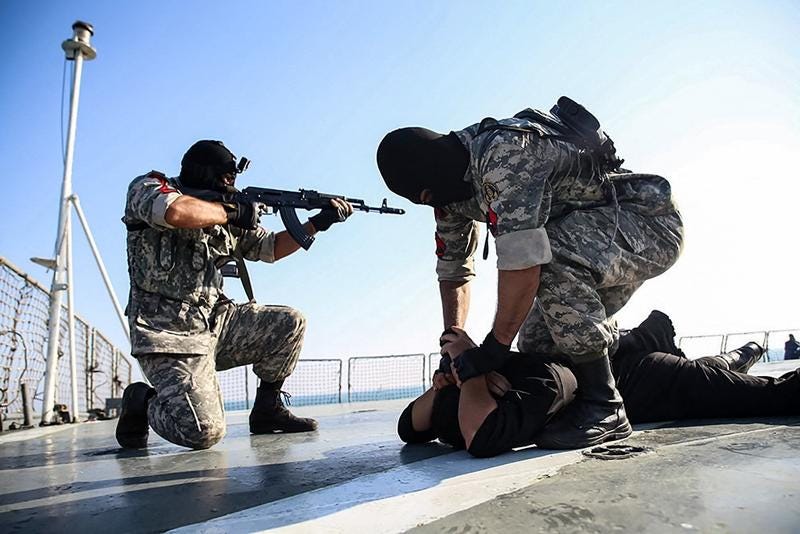
The regime in Tehran doesn’t need to win this war — it just needs to survive. If it does there will be a fierce and bloody reckoning with any Iranians who dare oppose it during these terrible days.
This uncertainty explains why the anti-regime demonstrations, which broke out over new year, have failed to reignite. It’s also why the few armed minority groups in Iran are cautious about taking advantage of the chaos and starting a popular uprising.
Iran is held together by force, not cohesion. For thousands of years it was known as Persia, but Farsi-speaking Persians have always been a small majority in a multi-ethnic country. The change came in 1935 when Reza Shah Pahlavi, after seizing power the previous decade, renamed it Iran to reflect this diversity.
The geography of Iran is desolate, unforgiving and gave rise to its ethnicities. Its periphery, other than the coastlines, is mostly made up of mountain ranges including the Zagros, Elburz and Makran. The interior is dominated by two vast salt deserts which are among the hottest places on Earth and can go years without rain. This is why most of the 92 million population live in the mountainous regions. This, in a country bigger than France, Germany and Britain combined, partially explains why the ethnic groups have distinct identities.
Because they are difficult to connect, populated mountain regions develop their own cultures. Ethnic groups cling to their identities and resist absorption, making it difficult for the state to foster national unity. Throughout history the country’s rulers have sought strong, centralised and often repressive systems of government to keep the minorities under control and ensure no region can break away or assist foreign powers.
Roughly 60 per cent of Iran’s population is Persian; among the rest are Azeris, Kurds, Arabs, Balochs, Lurs, Turkmen and Armenians, all of whom speak their own languages. There are even a few villages in which Georgian is spoken. The tiny community of Jews (about 8,000) can be traced all the way back to the Babylonian Exile in the 6th century BC. The state religion is Shia Islam, but Iran has Sunni Muslims, Zoroastrians and Baha’is.
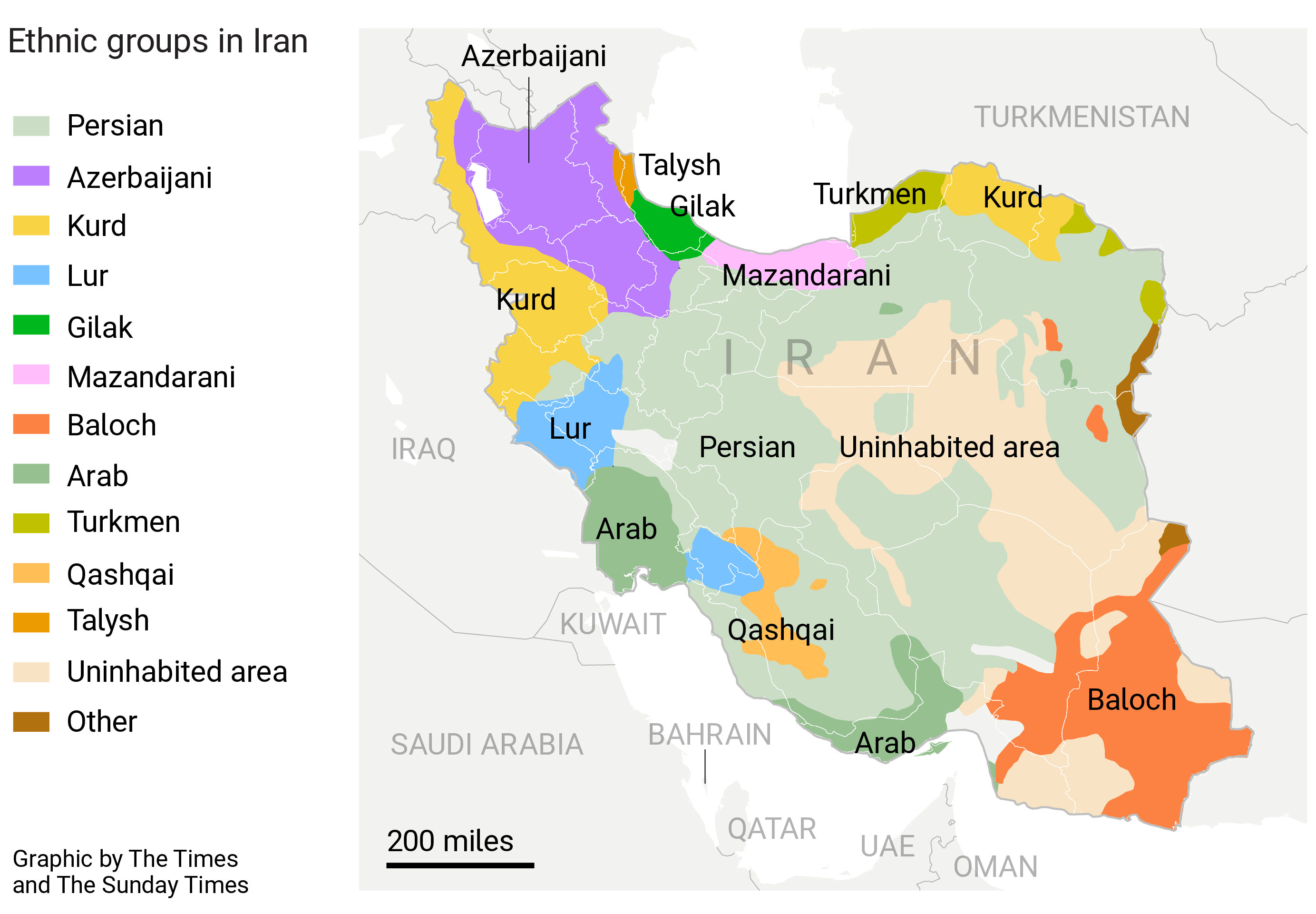
Turkic-speaking Azerbaijanis are the biggest minority, comprising about 16 per cent of the population. They reside mainly along the border with Azerbaijan and in Tehran. They have their differences with the regime but are well integrated. The late supreme leader Ayatollah Ali Khamenei was half Azerbaijani. So far there is no organised threat to the regime from this community.
That is not the case in the southeastern Baluchistan region, which borders Pakistan’s Balochistan province and is one of Iran’s poorest areas. Balochs are about 2 per cent of the population, comprising one or two million people. Sunni jihadist Balochs have been waging a low-level insurgency against the state for years. However, they are no more than a thorn in the regime’s side. In contrast there is a potential dagger in the northwest.
The Kurds are the best example of a mountain people retaining their culture in the face of aggressive state assimilation policies. There are roughly 40 million Kurds in the region and most live in Iran, eastern Turkey, northern Iraq and Armenia. In Iran they form about 10 per cent of the population, perhaps 8.5 million people, and are the second-largest minority. Most live in the Zagros mountains adjacent to the Kurds in Iraq and Turkey, with whom many share a dream of an independent Kurdish state.
Their language, independent spirit and the fact that most are Sunni Muslims in a Shia-dominated country have brought them into conflict with the central authorities for centuries. At the end of the Second World War, a small Kurdish region declared independence but survived less than a year once the central government had stabilised the country. Their most recent major uprising followed the Islamic Revolution of 1979, and it took the army three years to crush it. Since then, Kurdish groups based in Iraq have been conducting hit and run raids inside Iran.
This background helps make sense of some of the military targets hit by the Americans and Israelis since last weekend. The “decapitation” of Iran’s leadership last Saturday took the headlines, but over the following days the US and Israel carried out dozens of airstrikes across Iran’s Kurdish regions, including bases belonging to the Islamic Revolutionary Guard Corps (IRGC) and border regiments.
This appears to have been the groundwork for the potential flow of Kurdish forces from Iraq into Iran to further destabilise the regime. This in turn may open the way for nationwide street demonstrations. However, the regime has prepared for both eventualities.
Following last year’s 12-day war the IRGC re-enforced its troops in the Kurdish regions and has spent this week sending more there. It has also conducted drone attacks on the headquarters of the Iranian Kurdish military in Iraq.
A Kurdish incursion from Iraq would be fraught with danger. Forces would be coming through the Zagros mountain range, a barrier which has challenged invaders for millennia. It is difficult terrain for mechanised forces, and even infantry would be channelled into narrow passes which remain covered in snow. Depending on the routes taken, Kurdish forces could find themselves in West Azerbaijan, an Iranian province where local Azerbaijanis would not welcome them.
President Trump has spoken to the leaders of the two biggest Iraqi Kurdish groups this week and is said to have called Mustafa Hijri, who heads the largest Iranian Kurdish group, the Democratic Party of Iranian Kurdistan. Late last month it joined five other groups in the Coalition of Political Forces of Iranian Kurdistan. Thousands of fighters from one group, the Kurdistan Free Life Party, are thought to be on or just across the border.
However, the Kurdish leadership want guarantees from the Americans that they will not be abandoned as they have been in Iraq and Syria. The Kurds want independence or autonomy, not a suicide mission.
Several years ago, foreseeing a crisis like this one, Tehran decentralised command of the IRGC. It devolved decision-making to regional commanders, meaning they can continue operations even if communication with the capital is broken. These forces, along with the Basij militia they control, machinegunned thousands of protesters in January. They will not hesitate to do so again, especially against the ethnic minority groups, some of which bore the brunt of January’s massacres.
After Khamenei was killed, the regime moved quickly to send a signal to the country that it would survive his death. It was not a surprise that Ali Larijani of the National Security Council came to the fore. Larijani, who comes from a powerful clerical family, is close to the IRGC and the intelligence agencies. He played a major role in the suppression of January’s uprising and his prominence last week suggests that even after the naming of a new supreme leader, power may be shifting to the IRGC. It also reminds an anxious population that if they take to the streets again, they can expect a violent response.
This is why most of the myriad ethnic groups, religious minorities and dissidents need to see how things develop. On Thursday Trump was ambiguous about who might be in charge when the dust settles, saying: “We’ll work with the people and the regime to make sure that somebody gets there that can nicely build Iran but without nuclear weapons.”
So, what if the regime waits several weeks and the Americans say, as they did in June, that they have sufficiently degraded their targets to ensure Iran is no longer a threat, declare victory, open communication with Tehran and go home? Do they really want to trigger state collapse and potential civil war? That’s not a good look before the US midterm elections.
There are only two institutions in Iran capable of holding it together: the IRGC and the army, known as the Artesh. The IRGC is stronger and in Larijani has a pragmatist (albeit a brutal one) who can reopen negotiations. We saw in Venezuela that regime behaviour change was enough to leave the system intact after the removal of President Maduro.
That scenario leaves the regime battered but temporarily intact. It leaves its domestic opponents hurting, but not as much as the world of pain they would find themselves in if they gamble now and rise up. Better to watch and wait.
From an article first pubished in the Sunday Times. 8th March.
And once again, Mr Marshall shows why he is THE voice to be heard (or read). Tim - too few pronouncements from you, sir, make me shudder on a regular basis! This piece was incredibly informative and typically insightful. We need more of you...
Thank you, good to read a piece that is informative and not full of propaganda.